AI & Machine Learning
Why Your AI Conversation Gets Slower as It Gets Longer
Have you ever wondered that AI models feel snappier at the start of a conversation and slightly slower after a long exchange? That is not your imagination. There is a very specific reason it happens, and it comes down to something called the KV Cache.
The Problem It Solves
To understand the KV Cache, you first need to understand what happens inside a model every time it generates a token.
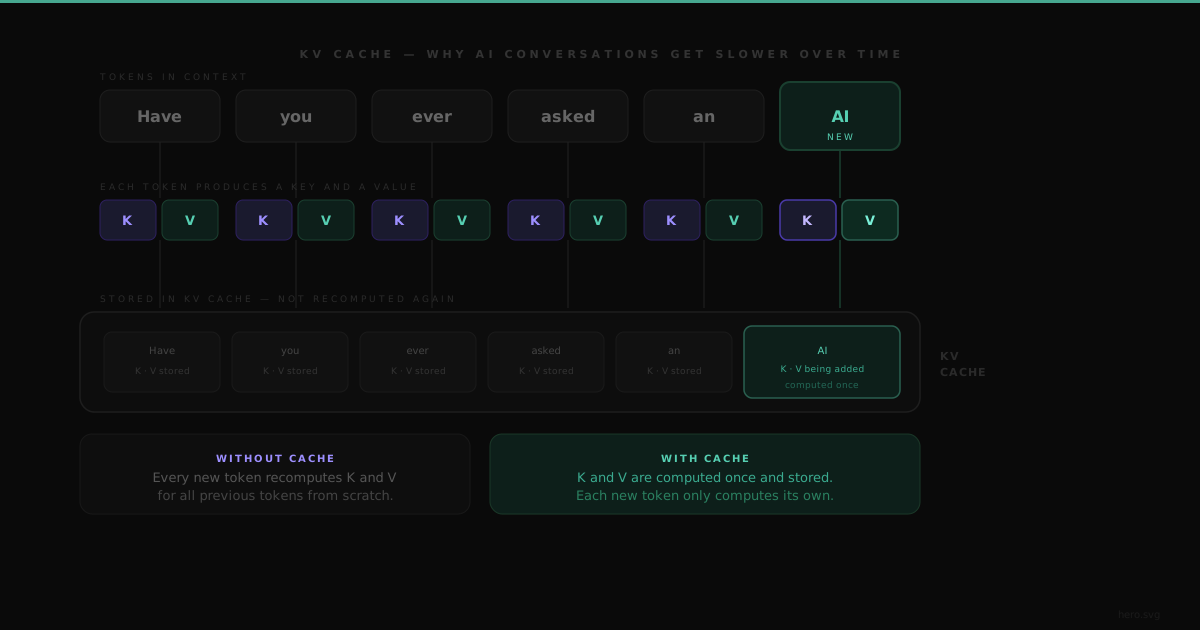
AI models built on transformer architecture use something called an attention mechanism. The job of attention is to help the model understand how each word relates to every other word in the conversation. To do this, every token produces two things internally called a Key and a Value.
Think of the Key as a label that says what this token is about. Think of the Value as the actual information that token carries. Together, every token contributes a Key and a Value that other tokens can look at to understand context.
Now here is the problem. Every time the model generates a new token, it needs to look at all the previous tokens to understand what comes next. Without any optimisation, it would have to recompute the Keys and Values for every single past token from scratch. For a long conversation that could mean thousands of recomputations on every single step. That would be impossibly slow for real time use.
What the KV Cache Actually Does
The solution is straightforward. Instead of recomputing, just remember.
After each token is processed, the model saves its Key and Value into a storage area called the KV Cache. The next time the model needs to look back at that token, it reads from the cache instead of recomputing from scratch.
Speed comes from not repeating work you have already done.
This single optimisation is what makes real time AI conversation possible. Without it, generating a response to a long message would take many times longer than it does today.
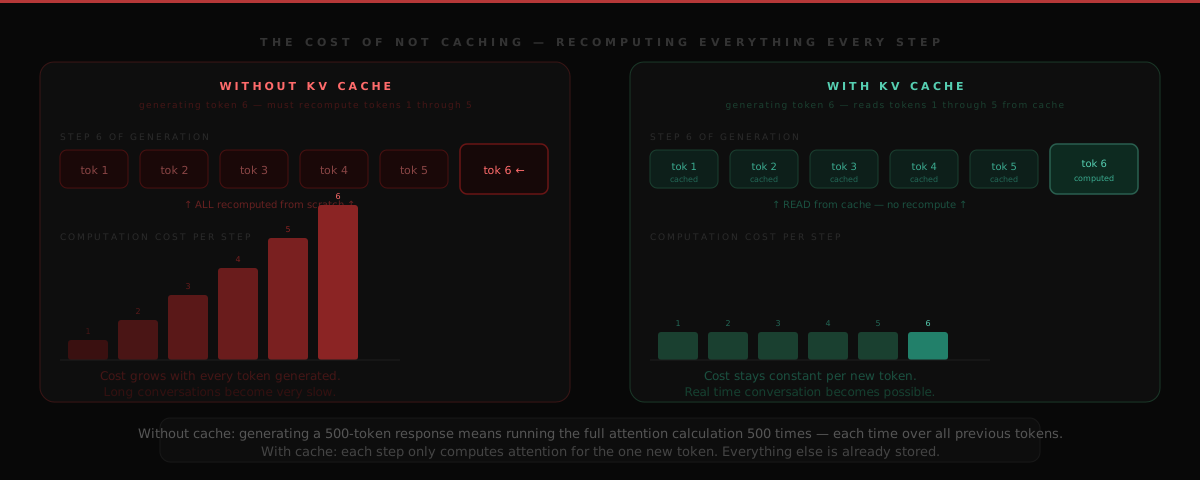 How the KV Cache stores Keys and Values instead of recomputing them every step
The Cost: Memory
Nothing is free. The KV Cache trades compute time for memory space.
Every token added to the conversation adds to the cache. A short conversation uses a small amount of GPU memory. A very long one can consume a significant amount. Research shows that a large model processing a 128,000 token context can require around 40 gigabytes of high bandwidth GPU memory just to store the KV Cache for that single conversation.
It is also why longer context conversations cost more to run in production. More tokens means a bigger cache. A bigger cache means more memory used per request. More memory per request means fewer simultaneous users can be served on the same hardware.
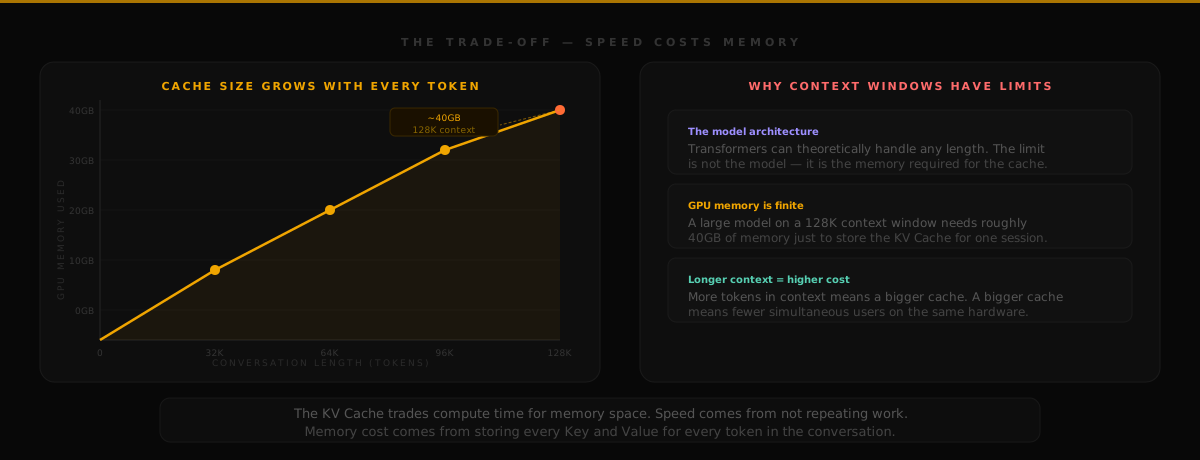 Cache size grows linearly with conversation length — and why that limits context windows
What Happens When the Cache Gets Too Big
When the KV Cache fills the available GPU memory, something has to give. Most systems either stop accepting more context, evict older tokens from the cache, or offload the cache to slower memory like CPU RAM.
Offloading to CPU RAM is slower but allows much longer contexts. Research from NVIDIA has shown that this approach can still deliver meaningful speed improvements compared to recomputing everything from scratch, even with the overhead of moving data between GPU and CPU.
What Researchers Are Working On
The KV Cache memory problem is one of the most actively researched areas in AI inference right now.
Cache compression. Instead of storing the full cache, can we store a compressed version that takes less memory but loses minimal accuracy? Some approaches published in 2025 have demonstrated over 50 percent memory savings while maintaining the same model quality on benchmarks.
Selective retention. Not every past token is equally important. Some methods analyse which tokens the model actually pays attention to and evict the ones that rarely get looked at. This keeps the cache lean without dropping things the model genuinely needs.
Shared caches. In production systems serving many users, parts of the conversation are often identical. A system prompt might be shared across thousands of users at the same time. Researchers are building systems that compute the KV Cache for shared content once and reuse it across all users rather than recomputing it for each request separately.
KV caching avoids redundant calculations and significantly accelerates autoregressive generation by reusing stored tensors for each new token's attention computation.
The Simple Version
Every token you send to an AI model produces internal data called a Key and a Value. Without caching, the model recomputes this data from scratch for every past token on every generation step. That is too slow for real use.
The KV Cache stores this data so it only needs to be computed once. The speed gain is substantial. The memory cost is real.
The longer your conversation, the larger the cache, the more memory it needs, and the more it costs to serve. This is the tradeoff sitting underneath every AI conversation you have ever had.
Sources: Sebastian Raschka's implementation guide, KVQuant at NeurIPS 2024, MorphKV 2025, and published benchmarks on Llama 3.1 70B for the 128K context memory figure.