AI & Machine Learning
Mixture of Experts: How Large AI Models Run Without Melting the GPU
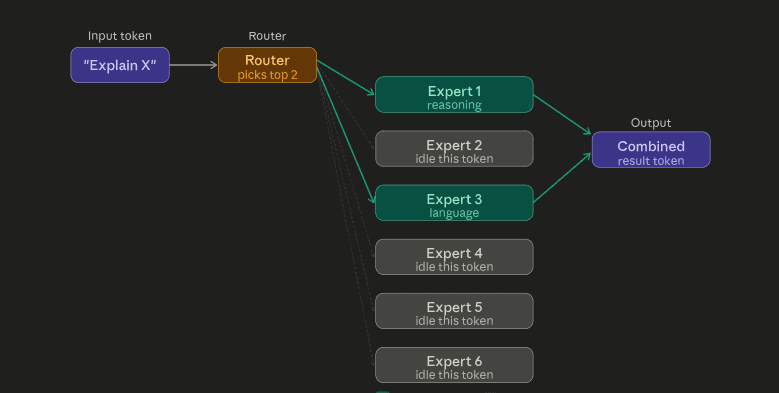
Have you ever wondered how a model with hundreds of billions of parameters runs without melting the GPU?
Most people assume bigger model means more compute per token. That is not how modern large models actually work. The technique behind it is called Mixture of Experts — and it changes everything about how you think about model size.
The Core Idea
Inside a large model, there are many smaller sub-networks called experts. Each expert is trained to be good at a specific type of task. Some specialise in code. Some in logical reasoning. Some in language translation.
But here is the key part.
For every single token the model processes, a small component called the router decides which 2 or 3 experts should handle it. The rest of the experts stay completely idle for that token.
So a model with 500 billion parameters might only activate 50 billion of them for any given token. You get the knowledge of a massive model but only pay the compute cost of a small one.
Why It Works
The reason this architecture is so effective comes down to three things working together.
The model can be enormous. Total parameter count — and therefore total knowledge capacity — can scale to hundreds of billions without being constrained by what a single forward pass can afford to compute.
Inference stays fast. Because only a small fraction of those parameters fire per token, the actual compute per token remains manageable. You are not running the full model on every word.
Experts specialise naturally. Over training, each expert gravitates toward the type of inputs it handles best. The router learns who is best at what. This specialisation is not manually programmed — it emerges from the training process itself.
The mixture-of-experts layer allows us to achieve model capacity far larger than would be possible within a fixed computational budget.
The Hard Part: Load Balancing
The biggest challenge with this architecture is not the routing itself. It is making sure the router does not play favourites.
If the router learns to send most tokens to the same 2 experts, those experts get heavily trained while the others barely update at all. You end up with a few overworked experts and many that never develop real capability.
This load balancing problem is one of the most actively researched areas in large model training. Getting it wrong wastes most of the model's capacity.
This Is Not a New Idea
Mixture of Experts as a concept was proposed in research as far back as the early 1990s. The idea of combining multiple specialised models with a gating mechanism is decades old.
What changed is the infrastructure. Training models of this scale requires enormous distributed compute, sophisticated load balancing techniques, and hardware that can efficiently route computation across many parallel expert networks. None of that existed at scale until recently.
Today the architecture underlies some of the most capable and cost-efficient large models in existence. It is not a future research direction — it is how production systems are built right now.
The Simple Version
If you remember nothing else, remember this.
A traditional dense model activates every parameter for every token. A Mixture of Experts model activates only a small subset — chosen by a router — and leaves the rest idle.
More parameters. Less compute per token. Smarter routing.That is Mixture of Experts.
The architectural paper that brought this approach to modern scale: Shazeer et al., Outrageously Large Neural Networks: The Sparsely-Gated Mixture-of-Experts Layer, 2017.